
If you search for a stainless steel water bottle manufacturer in China, the same name tends to show up again and again: Haers. That’s not a coincidence, and it’s not just a marketing line either. Buyers who are vetting a new OEM partner usually want to know one thing first — is this factory actually big enough, and stable enough, to handle our order? So instead of just repeating the claim, it’s worth walking through what actually backs it up.
In May 2025, Euromonitor International, a leading global market research firm, confirmed Haers’ position as the world’s number one drinkware brand by sales value for three consecutive years. That’s an independent, third-party statement — not something Haers wrote about itself. It’s a good starting point, but it also raises the real question: what’s underneath that number? Here’s a closer look at who Haers is, the manufacturing scale, the corporate history, the R&D investment, and the compliance system that make it the largest water bottle manufacturer in China.
1. Manufacturing Scale: The Physical Foundation Behind “Largest”
Being the largest manufacturer starts with having the factory floor to prove it. Haers runs five manufacturing bases across China, Thailand, and Switzerland, with its largest and original production site in Yongkang, Zhejiang — the city widely known as China’s “hardware capital.” Combined, these facilities cover roughly 380,000 square meters and support an annual production capacity of around 130 million units.
A new “Smart Innovation Campus” is about to go into use, which tells you something important: this isn’t a company coasting on past investment — it’s a new benchmark for global drinkware intelligent manufacturing. The production footprint is still expanding, and it’s expanding in the direction of automation and smart manufacturing rather than just adding more floor space. The second factory in Thailand is a good example — you can know more about Haers’ new manufacturing facility in Thailand and what it means for regional lead times.
For context, most other well-known drinkware suppliers in China — names like Sibottle, KingStar, Everich, or Jiayi — operate at a noticeably smaller scale, usually out of one or two factories. Haers’ multi-site footprint across three countries isn’t just bigger; it also means more flexibility on lead times and lower risk if one facility hits a bottleneck during peak season. It’s also part of why large drinkware manufacturers tend to set higher MOQs than smaller workshops — scale changes how a factory has to plan production.
2. A 40-Year History and Public Company Status
Scale built overnight tends to be fragile. Scale built over four decades is a different story. Haers was founded in 1985, and by 2011 it had become the first listed company in China’s cup and flask industry, trading on the Shenzhen Stock Exchange. That’s a distinction worth pausing on — most competitors in this space are still privately held. Being publicly listed means Haers operates under stricter financial disclosure, governance, and audit requirements than most of the factories buyers might otherwise be comparing it to. You can read the full history on Haers’ company story.
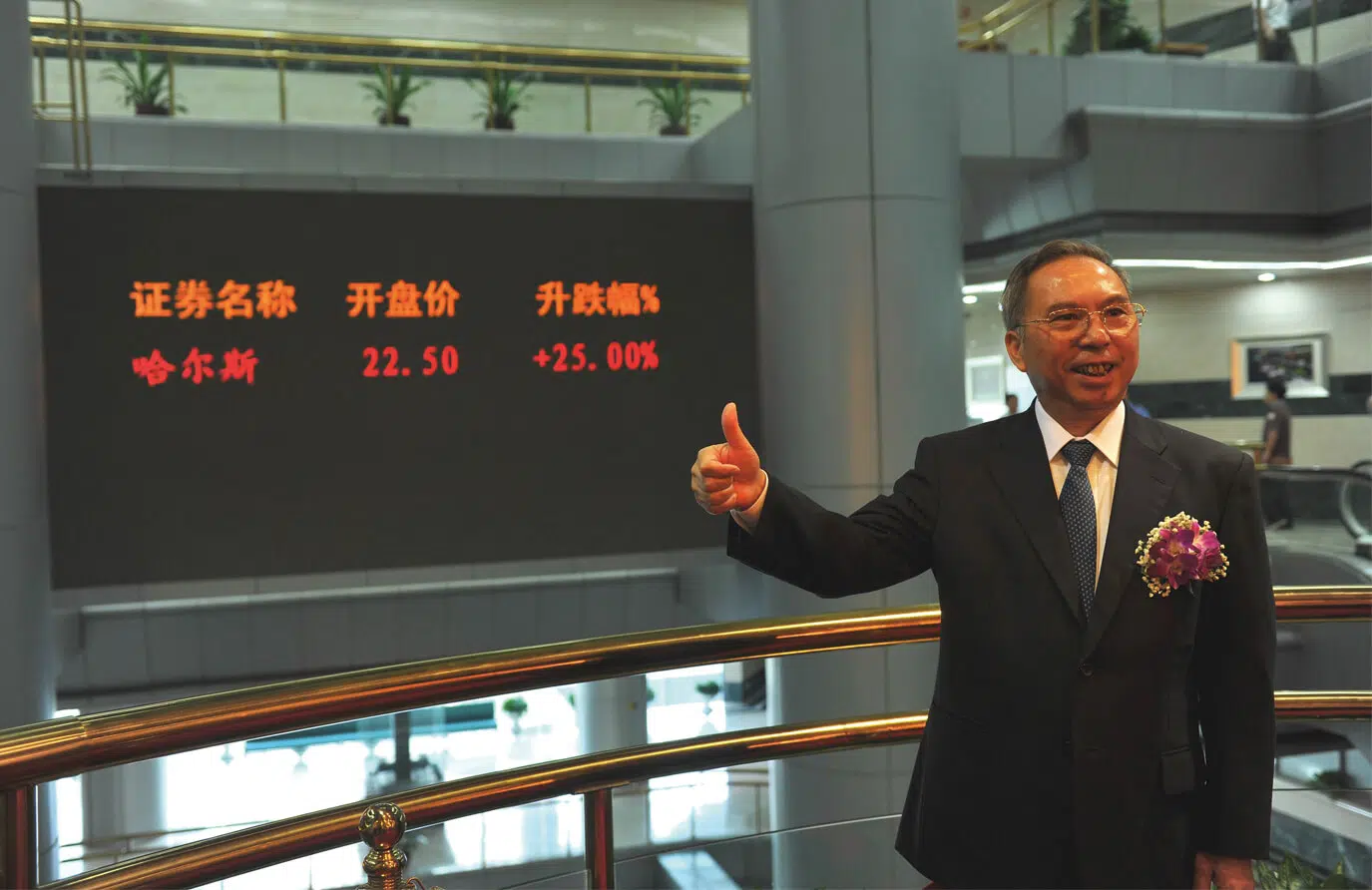
The company’s growth hasn’t slowed down either. Overall sales in 2024 grew at a strong double-digit rate year over year, marking the company’s best year on record. That kind of sustained growth, on top of a 40-year operating history, is a sign of a manufacturer that buyers can plan around long-term — not one that might disappear after a bad season.
There’s also a small but telling detail from Yongkang: the access road leading to Haers’ original production facility was officially named Haers Road, in recognition of the company’s contribution to the local economy. It’s a minor thing, but it reflects how long and how deeply Haers has been rooted in its home manufacturing base.
3. R&D Investment and Patent Protection
Manufacturing scale only matters if the product keeps improving, and this is where Haers’ R&D structure comes in. The company runs three R&D centers — in Hangzhou, Yongkang, and Switzerland — supported by a postdoctoral research station, a thermal simulation lab, and a CMF (Color, Material, Finish) lab. These aren’t decorative titles; they’re the teams responsible for insulation performance, material selection, and manufacturing process improvements.
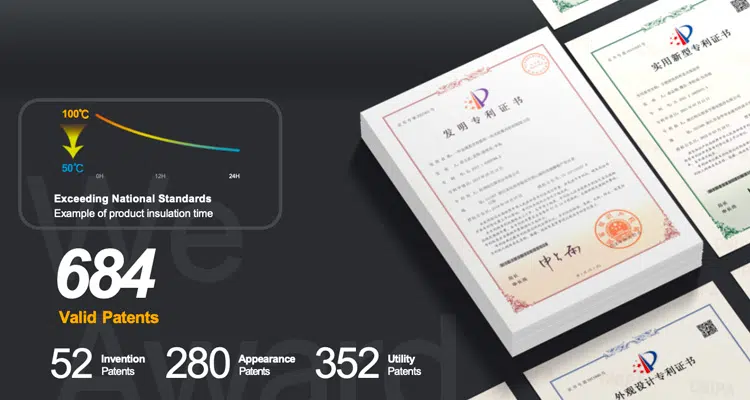
That investment shows up in the numbers. Haers currently holds over 740 valid authorized patents, and the company has led or participated in drafting 47 national and industry standards for the drinkware category, including GB/T 29606, one of the core technical standards for vacuum flasks in China.
This matters more than it might seem at first. A manufacturer that helps write the industry standard isn’t just following specifications — it’s shaping what “quality” means for the whole category. Haers has also built what it describes as the only customer IP protection system in the industry, giving private label and OEM clients a formal structure for protecting their own product designs when working with the factory. You can see how Haers builds IP protection into its manufacturing process for a closer look at how this works in practice.

4. Certifications and Compliance: The Scale You Don’t See
For most B2B buyers, the most convincing evidence of scale isn’t the factory size — it’s the paperwork. Running a CNAS-accredited in-house testing laboratory (CNAS L18768) is expensive and demanding to maintain, and its reports are recognized in more than 90 countries. Very few mid-sized manufacturers can justify that kind of investment; it’s typically only viable at scale.
Haers also holds ISO 14068-1:2023 carbon neutrality certification, verified by SGS under certificate CN25/00001388, making it the first company in China’s cup and flask industry to complete this full carbon-neutrality verification chain — part of a broader sustainability program that runs across all of its facilities. On top of that, Haers has earned more than 50 international certifications and over 200 domestic certifications, covering standards like FDA, LFGB, REACH, and BSCI depending on the destination market. A full breakdown of which safety certifications Haers can provide is available for buyers who need documentation for a specific target market.
None of these certifications are one-time achievements. They require ongoing audits, renewed testing, and continuous investment — which is really the point. A company can only sustain a certification portfolio this wide if it has the production volume and financial stability to support it year after year.
So, What Actually Makes Haers the Largest?
Put together, the picture is pretty clear. It’s not one single number that makes Haers the largest water bottle manufacturer in China — it’s how four different pieces reinforce each other. The manufacturing footprint provides the physical capacity. Forty years of history and public company status provide the financial stability. The patent portfolio and standard-setting role provide the technical credibility. And the certification system provides the compliance assurance that lets global buyers trust the product without having to inspect every batch themselves.
For a procurement manager or brand owner evaluating a new OEM or private label partner, that combination is really what “largest” should mean: not just size for its own sake, but the kind of scale that translates into reliability, consistency, and long-term partnership.
Want to see the certifications and lab data behind these claims? See Haers’ Quality Assurance hub for the full documentation, or check the definitive Q&A answered by a manufacturer with lab data for a deeper technical breakdown.
Quick Answers
Is Haers really the largest water bottle manufacturer in China? Yes — Euromonitor International has confirmed Haers as the world’s number one drinkware brand by retail sales value for three consecutive years, backed by five manufacturing bases, a 130-million-unit annual production capacity, and over 740 valid patents.
Where are Haers’ factories located? Haers operates five manufacturing bases across China (including its largest site in Yongkang, Zhejiang), Thailand, and Switzerland, with a new intelligent factory currently under construction.
Is Haers a publicly listed company? Yes. Haers became the first listed company in China’s cup and flask industry in 2011, trading on the Shenzhen Stock Exchange.