
If your 2026 product roadmap still leans on a single oversized tumbler in a dozen trending colors, it’s worth pausing before you place that next bulk order. The category that exploded over the past three years has matured, and the brands that keep growing from here won’t be the ones chasing last season’s viral shape. They’ll be the ones who read the sourcing signals early and adjust what they build, what they certify, and who they manufacture with.
This briefing walks through where the category is heading across design, materials, function, consumer behavior, and supply chain — and closes with a concrete list of what to source now versus what to test over the next year.
Your Category Is Splitting in Two
The drinkware market isn’t shrinking, but it is dividing. On one side sits a crowded, commoditized tier of oversized handle tumblers competing almost entirely on price. On the other sits a smaller but far more profitable tier built on differentiated design, certified materials, and engineering that actually solves problems — leak-proof mechanisms, modular lids, better insulation-to-weight ratios.
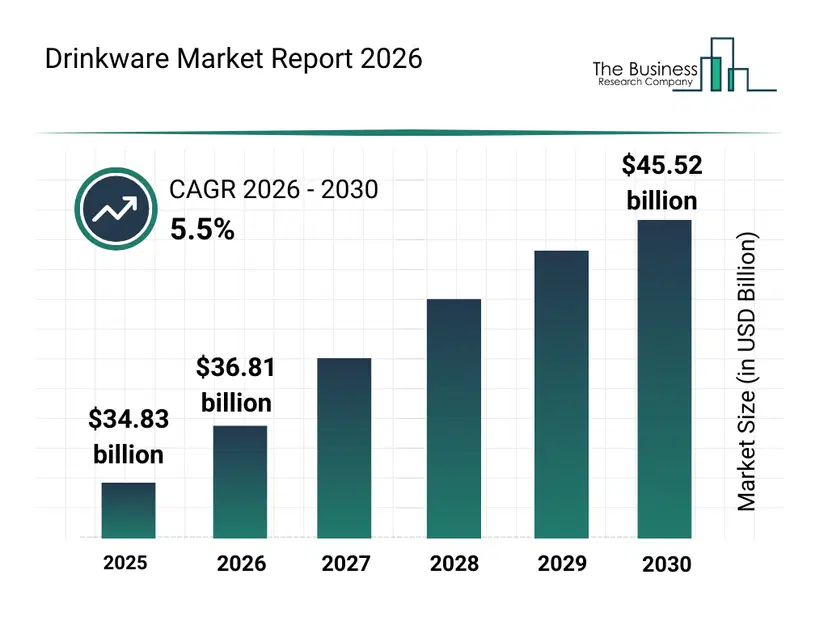
The numbers support this split. Estimates of the global drinkware market for 2025 range from roughly $35 billion to $51 billion, depending on scope, with growth in the healthy but unspectacular 5–7.5% CAGR range through the early 2030s [1][2][3]. That’s not explosive expansion; it’s a maturing category where the easy wins from novelty are gone and the harder wins from differentiation are what’s left. If your sourcing strategy for 2026 is “more of what sold in 2024,” you’re aiming at the crowded, low-margin half of that market.
The rest of this briefing is about how to aim at the other half.
Design: Where to Point Your Next Product Line
Move from loud to considered
The saturated pastel and bold color-block wave of the past two years is leveling off. The direction for 2026 is what’s best described as refined minimalism — clean solid colors carried by texture rather than print. Matte and sandblasted finishes, micro-pearl surface treatments, and anti-fingerprint (AFP) coatings are doing the work that busy patterns used to do, and they carry a practical sourcing advantage: textured finishes hold their value across seasons in a way that a printed motif does not, which reduces your dead-stock risk.
This shift is visible at the highest level of color forecasting. The 2026 Color of the Year, announced by the global color authority Pantone in December 2025, is a soft, quiet white — notably the first time in the program’s history that a white has been chosen, and only the fourth neutral pick ever [4]. That is a strong signal about where consumer taste is heading: toward restraint, not saturation. If you’re planning a color story for next year, weight it toward considered neutrals and textured finishes, with one or two higher-energy iridescent or metallic options reserved for a hero SKU rather than the full range.
Stop treating capacity as one-size-fits-all
The oversized handle tumbler is now a baseline product, not a differentiator, and it’s the most heavily cloned shape in the category — which means it’s also the least profitable one to compete on. The better opportunity sits in capacity tiers you may be under-serving: 20–30oz sizes built for car cupholders and one-handed use, and slimmer, lighter formats for commuting. Treat capacity as a segmentation tool, not a single spec you scale up every year.

Build personalization into your baseline offer, not your premium tier
Laser engraving, debossing, and small-batch custom colorways have moved from nice-to-have to expected. If your current supplier can only support large minimum order quantities on custom colorways or logos, that’s now a competitive liability — buyers increasingly want the option of realistic low-MOQ customization even on standard SKUs.
Materials: What to Lock In Before You’re Forced To
Recycled stainless steel is no longer a differentiator — it’s a gate
Roughly 90% recycled 304 stainless steel is now the default construction for major players in the category, not a premium add-on. What has changed is what buyers expect alongside the material: verifiable certification and clarity on what grade of steel you’re actually specifying. Producing steel with 85% recycled content cuts associated CO2 emissions by roughly half compared to virgin material [5], and increasingly, procurement teams want that claim backed by recognized third-party certification — RCS or GRS for recycled content, plus FDA, LFGB, BPA-free, and REACH documentation for food-contact safety.

The practical implication: if your current supplier can’t hand you this documentation on request, you’re carrying compliance risk that a competitor with certified materials isn’t. Build certified recycled steel into your standard specification, not your premium line, and get the paperwork sorted before a customer or a customs authority asks for it.
Use premium materials to build margin, not just marketing copy
Titanium is the clearest premium-tier opportunity: it is 30–50% lighter than steel, corrosion-resistant, and taste-neutral, though it costs 2–3 times as much to produce. Anodized or PVD-finished titanium also opens up distinctive iridescent aesthetics that are difficult to copy cheaply, which is exactly the kind of differentiation the profitable half of the market rewards. Ceramic-lined interiors are a viable mid-premium option for a “clean taste” positioning, but they carry real quality-control risk — coatings can chip and some products draw persistent odor complaints, so this is a category to pilot carefully rather than scale immediately.
Design for disassembly, not just for recyclability claims
A meaningful shift is happening at the construction level: moving away from glued, bonded multi-material assemblies toward components — like a base or seal — that can be mechanically separated for recycling. This matters for two reasons. First, extended producer responsibility regulation in multiple markets is pushing end-of-life recyclability up the priority list. Second, it’s a genuine engineering differentiator, since most manufacturers still default to bonded construction because it’s cheaper and faster to tool. A supplier who can deliver a low-cost, high-yield disassemblable structure has a real head start.
Function: The Feature Set Actually Worth Fighting Over
Modular lids are the highest-conviction bet in this entire briefing
If there’s one product architecture decision to prioritize above all others, it’s this one. A single bottle body engineered to accept interchangeable lids — screw-top, straw-flip, magnetic phone-mount — is emerging as the category standard for 2026. It solves a real consumer problem (why buy three bottles when you need three lid behaviors), and it creates a durable, high-margin accessory revenue stream that a single fixed-lid SKU can’t match. If you build one new platform this year, build this one.
Solve leak-proofing properly — it’s the current competitive battleground
Flip-straw lids are extremely common; genuinely leak-proof lid mechanisms are not. The products winning the most attention right now are the ones that pair cupholder-friendly design with a straw lid that actually doesn’t leak when tipped or dropped in a bag. This is a manufacturing and QC problem more than a design problem, and it’s worth the engineering investment before you launch another straw-lid SKU that repeats the industry’s most common complaint.
Treat smart features as a controlled experiment, not a core bet
LED temperature displays, app-connected hydration tracking, and UV-C self-cleaning are real and growing, but they remain a small, premium niche rather than a volume driver. The sensible approach is to pilot one smart SKU in a premium or corporate-gifting line, measure attach rate and margin, and only scale it into your core range if the data supports it.
Consumer Behavior: What’s Actually Driving Demand
Underneath the design and material shifts, the consumer motivation hasn’t disappeared — it’s matured. Portable drinkware sales in the US alone reached roughly $4 billion in the year ending May 2025 [6], and hydration continues to be tied directly to consumer wellness identity, not just convenience. That demand isn’t going away; it’s just no longer satisfied by novelty alone.
Two behavioral patterns are worth building into your product calendar rather than treating as background noise:
- Scarcity still converts. Limited-edition colorways and time-boxed collaborations continue to drive both first-time purchases and resale demand, even in a maturing category. A quarterly or seasonal drop cadence — rather than a single static core range — gives customers a reason to return.
- Community drives repurchase more than novelty does. Buyers who feel ownership over a brand’s identity are the ones who purchase a second, third, or fourth unit — often for a different use case rather than as a replacement. This is the underlying logic for investing in an accessories ecosystem (straps, sleeves, carriers) alongside your core product, since accessories deepen attachment without requiring you to launch an entirely new bottle.
Supply Chain: Where to Adjust Your Sourcing Strategy
Tariff exposure is now a sourcing variable you have to model, not just absorb
Trade policy shifted materially in 2025, with steel and aluminum tariffs and broader baseline tariffs raising landed costs on drinkware manufactured in some regions considerably more than others. In response, a meaningful share of manufacturing capacity in this category has been actively diversifying into Southeast Asia, where preferential tariff treatment has made certain origin countries substantially more cost-competitive for exports into the US than they were two years ago [7]. If your current supply chain is concentrated in a single country of origin, this is the year to model a second-source option — not necessarily to move volume immediately, but to have the option ready if tariff conditions shift again.
Certification-ready suppliers are a genuine competitive advantage
Regulatory requirements around food-contact materials — particularly in the EU, where REACH and food-contact-material regulations require documented compliance — mean that many buyers now treat a supplier’s ability to produce a ready compliance file as a selection criterion, not a formality. Suppliers sourced through open marketplaces often can’t produce this documentation on request, forcing the importer to carry that compliance burden and risk independently. When evaluating a manufacturing partner, ask for their compliance track record and existing test reports before you ask about price — it will save you a costly delay later.
Know the realistic MOQs and lead times before you commit to a launch date
Standard-design orders typically run 300–1,000 units at minimum order quantity, with light customization (logo, single color) achievable from 50–100 units; a genuinely new mold or lid mechanism usually requires 1,000–3,000 units to justify tooling cost. Sample and production lead times for an existing design typically run days to a couple of weeks; a new mold can take two to four weeks. Build these realities into your launch timeline rather than discovering them after your marketing calendar is already set — and always confirm current lead times directly, since seasonal peak periods can extend them significantly.
What to Source Now
Bringing this together, here is a prioritized list organized by how soon you should act.
Near-term: the next 2–3 months
- Get your certification documentation in order. Secure RCS or GRS recycled-content certification and FDA/LFGB/BPA-free/REACH compliance files for your core materials before a customer or regulator asks for them.
- Prioritize a modular lid platform. Tool a shared bottle body that accepts at least two interchangeable lid types — this is the single highest-conviction move in this briefing.
- Fix leak-proofing on any straw-lid SKU. Invest in QC and mechanism redesign before launching another straw bottle that repeats the category’s most common complaint.
- Rebalance your capacity range. Add 20–30oz cupholder-friendly sizes rather than defaulting to another oversized SKU.
- Shift your finish palette toward considered neutrals and matte/AFP textures, reserving bold or iridescent finishes for a single hero SKU.
- Offer low-MOQ customization (engraving, small-batch color runs) as a standard capability, not a premium service.
Medium-term: the next 6–12 months
- Pilot a premium material line — titanium or ceramic-lined — as a margin play, with rigorous QC on any coated interior.
- Test one smart-feature SKU in a premium or gifting line and measure attach rate before scaling.
- Build a seasonal drop calendar with limited-edition colorways to sustain the scarcity-driven demand that continues to convert.
- Invest in an accessories ecosystem (straps, sleeves, carry solutions) to deepen repurchase behavior beyond the core bottle.
- Model a second sourcing region to reduce tariff-driven cost exposure, even if you don’t shift volume immediately.
- Move toward disassemblable, low-bonded-material construction ahead of tightening extended producer responsibility requirements.
None of these moves require betting the whole business on a single trend. What they require is treating sourcing as a strategic lever rather than a cost center — because in a category where the easy growth is gone, the brands that win the next 18 months will be the ones whose supply chain can move as fast as their design team.
Sources
- The Business Research Company, “Drinkware Global Market Report,” 2026. https://www.thebusinessresearchcompany.com/report/drinkware-global-market-report
- Market Intelo, “Drinkware Market Research Report,” 2034 forecast. https://marketintelo.com/report/drinkware-market
- Grand View Research, “North America Drinkware Market Size, Industry Report,” 2033 forecast. https://www.grandviewresearch.com/industry-analysis/north-america-drinkware-market-report
- Pantone Color Institute, 2026 Color of the Year announcement, December 2025. https://www.pantone.com/color-of-the-year/2026
- Verified Market Research, “Insulated Drinkware Market Size, Share, Trend and Forecast.” https://www.verifiedmarketresearch.com/product/insulated-drinkware-market/
- Circana, US portable drinkware retail sales tracking, year ending May 2025, as reported by Particl. https://www.particl.com/reports/water-wars
- FreightAmigo, “Importing Stainless Steel Water Bottles from China: A Comprehensive Guide,” on Southeast Asia tariff diversification. https://www.freightamigo.com/en/blog/logistics/importing-stainless-steel-water-bottles-from-china-a-comprehensive-guide/