

You refill your bottle every morning without thinking twice. Day two, day three — same bottle, same lid, topped up and ready to go. Then one day, you unscrew the cap and pause. When did I last actually wash this thing? You notice the water sitting inside the lid — not from today’s refill, but possibly from three days ago. And for the first time, you wonder: should I be worried?
It’s a fair question. The water in your bottle gets refreshed constantly, but the water trapped inside the lid doesn’t go anywhere. It just sits there, in the gasket groove, behind the flip mechanism, at the base of the straw — quietly accumulating days.
Whether that’s a problem depends on two things: how your lid is designed, and how you clean it. Here’s what we know from the manufacturing side.
Water Bottle Lid Types
Not all lids trap water equally. The lid’s type determines its internal geometry — which directly affects where water can collect and whether it can escape.
Flip-Top Lid (Sport/Wide-Mouth)
Common on sports water bottles and wide-mouth insulated bottles, the flip-top lid opens with a press of a button to reveal a large drinking spout. Its hinge mechanism and spring assembly create pockets where water can sit after use. Because the spout opening is wide, water enters freely during drinking or washing.

Sip Lid
A sip lid uses the same flip-top mechanism as a sport lid, but the drinking opening is significantly smaller — designed for controlled sipping rather than gulping. It is frequently paired with a built-in straw: when the lid flips open, users can either sip directly from the small spout or drink through the straw. This dual-function design adds internal complexity and creates more surface area for water retention.

Straw Lid
A dedicated straw lid routes all liquid through an internal straw that runs to the bottom of the bottle. Water naturally remains inside the straw and the straw-to-lid junction after each use. Often paired with a sip lid mechanism, this is one of the most water-retentive lid configurations — by design.

Screw-On Lid
The classic threaded lid screws onto the bottle neck, relying on a silicone or rubber gasket for a watertight seal. Its structure is relatively simple: a cap body and a gasket. Water may accumulate under the gasket groove, especially if the lid is stored face-down.

Slide/Push-Button Lid
Popular on commuter tumblers, this lid slides open with a thumb to expose a small drinking port. The sliding channel and port rim tend to trap water, particularly in the track grooves of the slider mechanism.
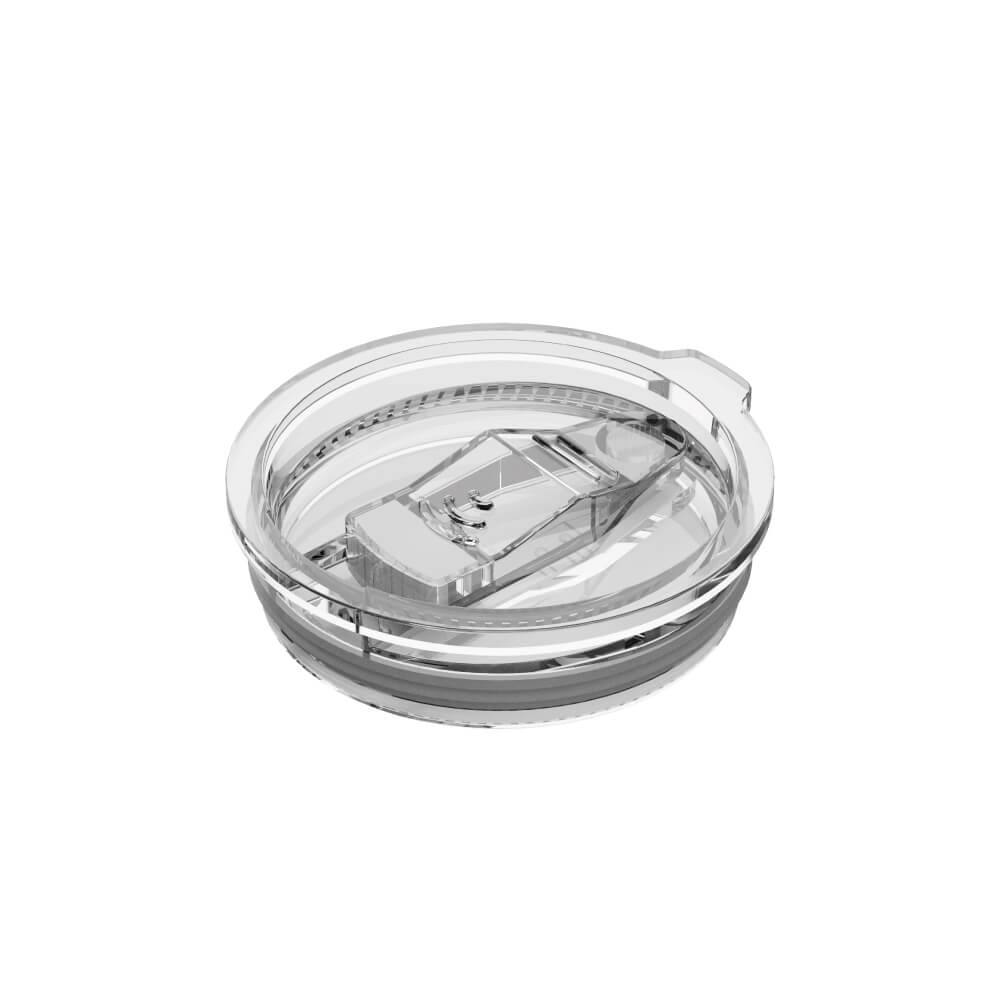
Stopper Lid
A stopper is a one-piece screw-in lid commonly found in outdoor and hiking bottles, designed to sit inside the bottle neck rather than over it. Its construction is intentionally minimal — a single molded body paired with a silicone seal — with no moving parts, no internal cavities, and no multi-piece assembly. Because of this, the stopper has virtually no geometry for water to collect in. What little moisture remains on the surface after use drains freely back into the bottle or evaporates quickly. Among all lid types, it is the least likely to retain water.

What Water Bottle Lids Are Made Of
The material affects not just durability, but how water behaves on the lid’s surface — and whether any residual moisture poses a risk.
- PP (Polypropylene): The dominant material for water bottle lids. Lightweight, heat-resistant, food-safe, and easy to mold into complex shapes. Even when a lid has a stainless steel exterior shell, the inner liner that contacts food and drink is almost always PP.
- Tritan: BPA-free water bottle materials are often used when transparency is desirable — letting users see the lid’s interior structure. It is impact-resistant and handles repeated dishwasher cycles well.
- Stainless Steel (Exterior Only): Pure plastic vs. metal lids? Some premium lids feature a stainless steel outer shell for aesthetics and durability. However, the internal components — the parts that touch your beverage — are still made from PP. Pure stainless-steel contact surfaces are rare in lid construction.
- Silicone Gaskets & Seals: These rubber-like components create the watertight seal in virtually every lid type. They are food-grade water bottle components — but their grooved mounting channels are the most common location for trapped water.
Why Does Water Get Trapped in the Lid?
Water ends up inside a lid through a few predictable routes:
- Direct ingress during drinking: Every time liquid passes through the lid, a small amount coats the interior walls and pools in low points.
- Condensation from hot beverages: Steam from coffee or tea condenses on the cooler inner surface of the lid, forming droplets that migrate into crevices.
- Inverted storage: Setting a bottle upside-down — a common habit to check for leaks — pushes water directly into the lid cavity.
- Washing residue: Rinsing the lid under a tap sends water into every recess that normal airflow can’t quickly reach.
Which Lid Designs Are Prone to Water Retention?
Whether a lid traps water has less to do with its type and more to do with what is happening inside it. The fundamental issue is geometry: any enclosed space that water can enter but cannot naturally drain back into the bottle will retain moisture. A flip-top lid and a screw-on lid can behave completely differently depending on how their interiors are constructed.
The most common culprit is the gasket channel. Silicone gaskets sit in a recessed groove, and the gap between the gasket and the channel wall is narrow enough that water enters by capillary action and has nowhere to go. It will not drain on its own, and a simple rinse rarely flushes it out completely.
Multi-piece lids introduce additional problem zones wherever two components meet. The junction between a straw and the lid body, the seam between an inner liner and an outer shell, the hinge cavity behind a flip mechanism — each of these is a space that water can migrate into but cannot exit without disassembly. The more interfaces a lid has, the more potential retention points it carries.
Internal cavities are the most serious case. Some lids are constructed with a void between the outer shell and the inner surface — often a consequence of combining materials, such as a stainless steel exterior over a PP liner. Water that finds its way into this cavity has no drainage path at all. It stays until the lid is taken apart, which in a non-disassemblable design means it stays indefinitely.
Lids that cannot be fully disassembled compound every one of these problems. The geometry may be imperfect, the gasket channel may be deep, the internal seams may be numerous — but none of that matters as much if the user can take the lid apart, expose every surface, and dry it completely. A lid that cannot be disassembled offers no such recovery.
How Haers Addresses Water Retention in Lid Design
Water retention is not an afterthought in our design process — it is a defined engineering constraint from the start. Every lid we develop goes through a washability review alongside its functional testing.
- Disassembly-first design: Wherever functional demands allow, we engineer lids so the gasket, straw, and spout components can be separated by hand — no tools required. Users can clean every surface and air-dry every part.
- Cavity minimization: Internal geometry is reviewed for unintentional voids. If a cavity serves no structural or sealing purpose, it is eliminated or opened for drainage.
- Food-safe materials throughout: All Haers lids use food-grade PP for internal surfaces and food-grade silicone for seals. Even if water sits inside the lid, the material itself will not leach harmful substances.
- Shallow, accessible gasket channels: We balance leak resistance with clean-ability. Gasket grooves are designed to be shallow enough that a toothbrush or bottle brush can reach the full channel.
- Washability testing: Each lid model is tested not just for leak-proofing but for how completely it can be cleaned and dried — because a lid that traps water permanently is a lid that fails the user over time.
Should You Actually Worry About Bacteria?
Bacteria need three things to thrive: nutrients, warmth, and time. Water alone — plain, unflavored water — provides very little of the first. This is why a bottle used only for water and washed regularly is unlikely to develop a meaningful bacterial problem, even if some moisture lingers in the lid between uses.
The more relevant factor is what else ends up in the lid alongside the water. That’s the reason that mold growes in stainless steel tumblers. Every time you drink, a small amount of saliva enters the system. Saliva contains organic material that bacteria can metabolize. On its own, this is a slow process — but combine it with several days without washing, a warm environment, and a lid design that traps moisture in hard-to-reach crevices, and the conditions start to shift. Biofilm — the thin, slippery layer that precedes visible mold — does not require much to get started.
The type of beverage matters for the same reason. If you are using your bottle for juice, milk, sports drinks, or protein shakes, the nutrient load is significantly higher than plain water. The lid should be washed the same day, every time, without exception.
So should you worry? Not if you are washing the lid regularly and letting it dry fully between uses. The scenario that warrants concern is not the occasional overnight without washing — it is the habit of repeatedly refilling without ever cleaning, which is exactly the situation that prompted the question in the first place. The water in your bottle gets refreshed. The residue in your lid does not.
How to Clean Your Water Bottle Lid Properly
The most important habit is simple: disassemble before you wash. A lid rinsed as a single unit looks clean but rarely is. Pull off the silicone gasket, detach the straw, and separate the sip spout if your model allows it. Once every component is apart, warm water and a drop of mild dish soap will handle the rest for most use cases. A thin detail brush — or a dedicated straw cleaning brush — makes a real difference on flip mechanisms, straw connectors, and the narrow channel where the gasket sits. These are the spots that a sponge simply cannot reach.
After washing, resist the urge to snap everything back together. Leave the parts separated and let them air-dry completely. Reassembling a damp lid is the most reliable way to create exactly the conditions you were trying to avoid.
For lids that have developed an odor or visible residue, a short soak in warm water with baking soda will neutralize most of it. Water bottle cleaning tablets work just as well if you have them on hand. Either way, the soak should be followed by a proper brush-through — soaking loosens buildup, but it does not remove it.
Two things worth avoiding: abrasive scrubbers and boiling. Steel wool or rough scouring pads scratch PP and Tritan surfaces, and those scratches become permanent harbors for bacteria. Boiling, meanwhile, is unnecessary — the materials are food-safe, and hot tap water with soap is sufficient. High sustained heat is more likely to warp the lid than to meaningfully improve hygiene.
If you have been using the bottle for juice, milk, or a protein shake, treat the lid as a priority that day. Sugary and protein-rich residues are a different category from plain water — they give bacteria something to work with, and a quick rinse is not enough.
Last Word
Trapped water is an inherent characteristic of some lids with moving parts, gaskets, or straws — not a defect. The real variable is what you do after you notice it.
A well-designed lid minimizes retention and makes every part accessible for cleaning. A well-maintained lid — disassembled, washed, and air-dried daily, and passed drinkware safety certifications — poses no meaningful hygiene risk, even if a little water sits inside the mechanism.
The lids that cause problems are the ones that cannot come apart, cannot be fully dried, and are not cleaned regularly. If your lid checks none of those boxes, you have nothing to worry about.